Email Marketing Strategy: The Complete Guide to Building a Revenue-Generating Email Program
Hey there! Ever feel like you're just throwing emails at the wall and hoping something sticks? You're sending campaigns, tracking opens and clicks, but there's no real plan tying it all together. I get it—most businesses treat email marketing like a tactical checkbox instead of the strategic revenue engine it should be.
Here's the reality: companies with a documented email marketing strategy generate 30% more revenue per subscriber than those winging it. The difference between a $50K email program and a $5M email program isn't better subject lines—it's strategic thinking.
I've generated over $200 million in email marketing revenue across hundreds of brands, and the ones that crush it all follow the same strategic framework. This isn't about tactics. This is about building an email marketing strategy that turns subscribers into revenue, predictably and at scale.
What is Email Marketing Strategy (And Why Most Get It Wrong)
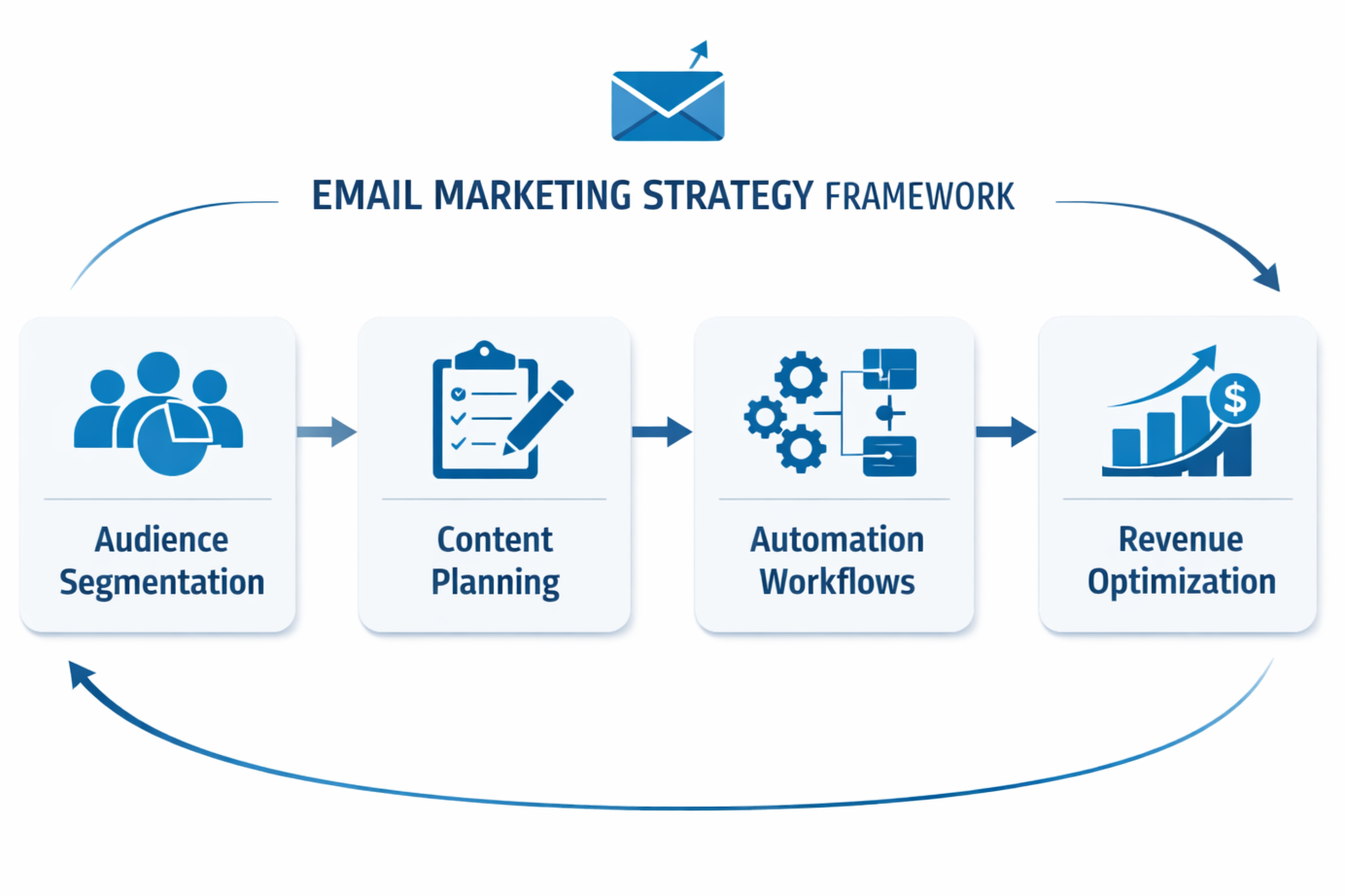
Email marketing strategy is your documented plan for acquiring subscribers, nurturing relationships, and driving revenue through email. It's not your editorial calendar. It's not your automation workflows. Those are tactics that come from strategy.
Most businesses confuse activity with strategy. They're sending emails, building flows, A/B testing subject lines—but they have no idea how it all connects to business goals. That's backwards.
Real email marketing strategy answers these questions:
Who are we trying to reach and why should they care?
What business outcomes are we driving with email?
How do we acquire, segment, and nurture our audience?
What's our content framework and messaging hierarchy?
How do we measure success and optimize for growth?
Without clear answers, you're just sending emails and hoping for the best. With strategy, every email has a purpose and moves subscribers toward revenue.
Why this matters: Companies with documented email marketing strategies see average ROI of $42 for every $1 spent, compared to $18 for those without strategy. That's not a small difference—it's the difference between email being a nice-to-have and being your most profitable channel.
Building Your Email Marketing Strategy Foundation
Before you write a single email or build a single automation, you need strategic clarity on three foundational elements.
Define Your Email Marketing Business Objectives
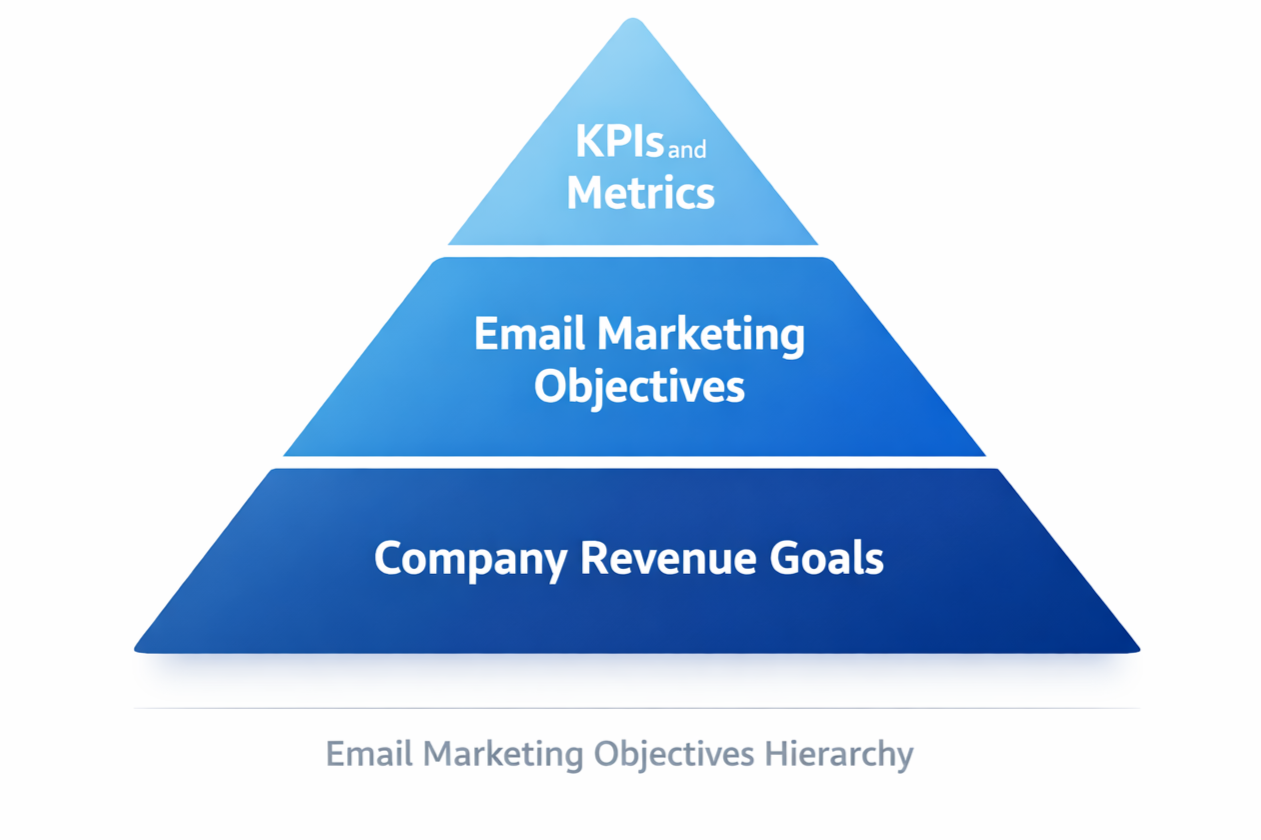
Your email strategy must connect directly to business goals. "Get more opens" isn't a business objective. "Increase customer lifetime value by 25%" is.
Common email marketing business objectives:
Revenue Growth
Increase email-attributed revenue by X%
Grow average order value by X%
Drive X% of total company revenue through email
Customer Acquisition
Acquire X new email subscribers monthly
Convert X% of subscribers to customers
Reduce customer acquisition cost by X%
Customer Retention
Increase repeat purchase rate by X%
Extend customer lifetime value by X%
Reduce churn by X%
Engagement and Loyalty
Increase email engagement rates by X%
Grow highly-engaged segment by X%
Build community of X brand advocates
Pick 2-3 primary objectives. More than that and you'll lack focus. Every strategic decision should trace back to these objectives.
Example: If your primary objective is increasing customer lifetime value, your strategy will emphasize post-purchase engagement, loyalty programs, and retention campaigns. If it's acquisition, you'll focus on lead generation, welcome series optimization, and conversion campaigns.
Identify and Segment Your Target Audience
You can't build effective email marketing strategy without knowing exactly who you're talking to. Not demographics—psychographics, behaviors, and needs.
Strategic audience segmentation framework:
Lifecycle Stage Segmentation
Subscribers (not yet customers)
New customers (0-30 days)
Active customers (repeat purchasers)
At-risk customers (haven't purchased recently)
Churned customers (inactive 90+ days)
Behavioral Segmentation
Purchase frequency (one-time vs. repeat buyers)
Product category preferences
Engagement level (active vs. passive)
Channel preferences (email vs. SMS vs. social)
Value-Based Segmentation
High-value customers (top 20% revenue)
Medium-value customers (middle 60%)
Low-value customers (bottom 20%)
Growth potential (showing increasing value trend)
Need-Based Segmentation
Pain points they're solving
Goals they're trying to achieve
Objections preventing purchase
Information they need to decide
Each segment needs different messaging, offers, and content. Your strategy should outline how you communicate with each audience segment differently.
Pro tip: Start with lifecycle stages. You can always add behavioral and value-based segments later. But every email program needs different approaches for prospects vs. new customers vs. loyal customers.
See specific email examples for each audience segment in our comprehensive guide to email marketing examples.
Map Your Customer Journey and Email Touchpoints
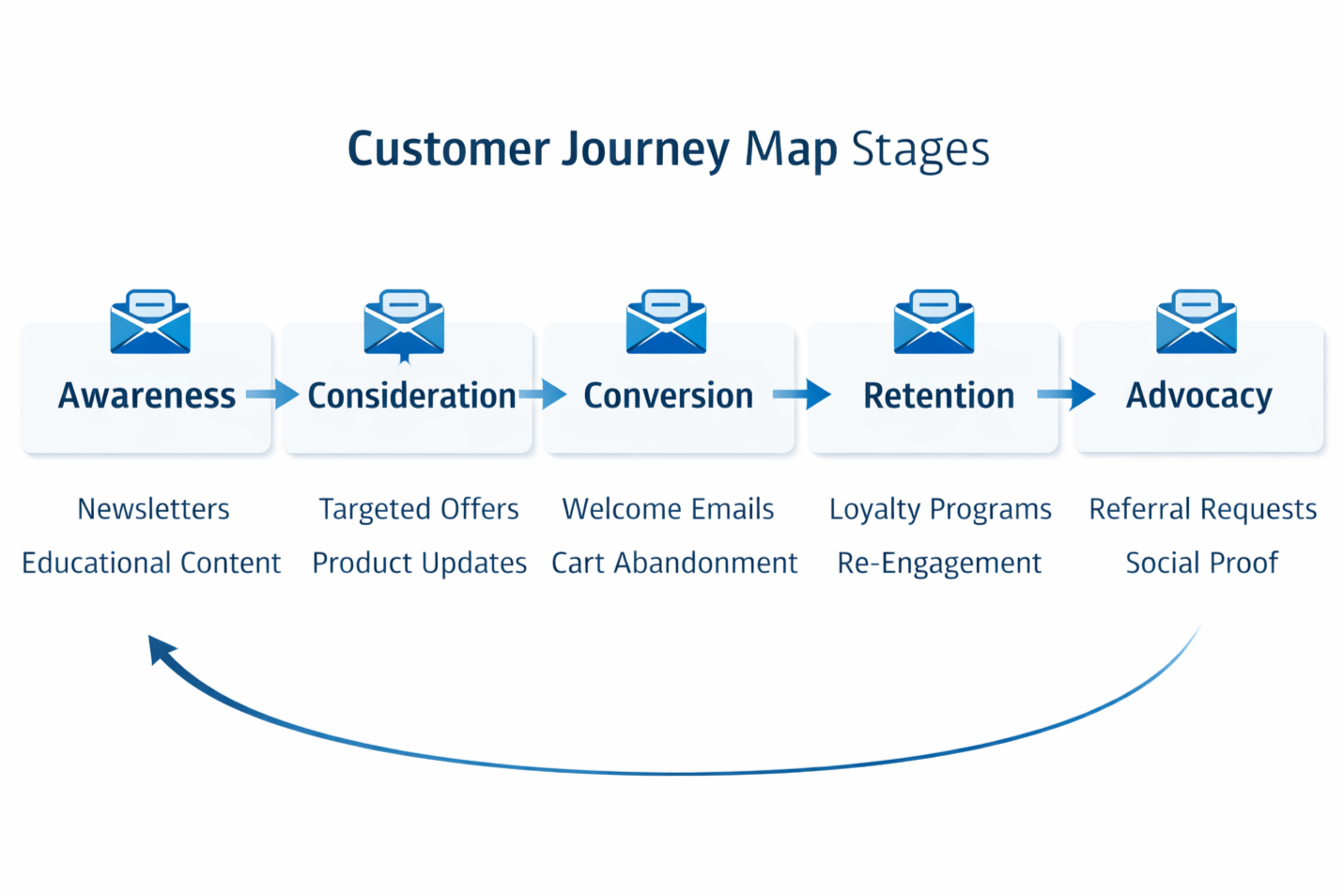
Your email marketing strategy needs to map every stage of the customer journey and identify where email adds value.
Complete customer journey mapping:
Awareness Stage
How do people discover you?
What's their first email touchpoint?
What content introduces your brand?
Goal: Build awareness and capture interest
Consideration Stage
What information do they need to evaluate?
What objections must you address?
What social proof influences decisions?
Goal: Position your solution as the best choice
Conversion Stage
What triggers purchase decisions?
What final objections remain?
What offer converts prospects to customers?
Goal: Drive first purchase
Retention Stage
How do you ensure product/service success?
What drives repeat purchases?
How do you increase lifetime value?
Goal: Build long-term customer relationships
Advocacy Stage
What turns customers into advocates?
How do you encourage referrals?
What makes customers share their experience?
Goal: Generate word-of-mouth growth
Map specific email campaigns and automations to each journey stage. This ensures you have strategic coverage across the entire customer lifecycle.
Core Components of Email Marketing Strategy
Every effective email marketing strategy includes these essential strategic components working together as an integrated system.
List Building and Growth Strategy
Your email list is your most valuable owned asset. List growth strategy determines how fast you can scale revenue.
Strategic list building framework:
Lead Magnets and Incentives
High-value content offers (guides, templates, tools)
Exclusive discounts for new subscribers
Early access to products or content
Educational courses or email series
Free trials or demos
Conversion Optimization
Pop-ups (timed, exit-intent, scroll-triggered)
Embedded forms throughout website
Landing pages for specific offers
Social media lead generation
Checkout page signup options
Growth Channels
Organic website traffic capture
Paid advertising to landing pages
Social media audience conversion
Partnership and co-marketing
In-person event signups
Referral programs
Quality vs. Quantity Balance
Target growth rate (realistic based on traffic)
Acceptable cost per acquisition
Engagement rate thresholds
Unsubscribe rate tolerance
List hygiene protocols
Your strategy should include specific growth targets, conversion rate goals for each channel, and quality metrics to ensure you're building an engaged list, not just a big one.
Real example: A client was adding 5,000 subscribers monthly through popup forms but seeing 15% engagement. We shifted strategy to educational lead magnets, reduced volume to 2,000 subscribers monthly, but increased engagement to 45%. Result: 2x revenue with fewer subscribers.
Master subject line strategy with our guide to 87 email subject lines that actually get opened.
Content Strategy and Editorial Planning
Content strategy determines what you send, when you send it, and why it matters to subscribers. This goes beyond just planning emails.
Email content strategic framework:
Content Pillars (3-5 core themes)
What topics position you as the authority?
What information does your audience need?
What content differentiates you from competitors?
What stories reinforce your brand values?
Example for e-commerce brand:
Product education and use cases
Industry trends and insights
Customer success stories
Behind-the-scenes and brand story
Exclusive offers and launches
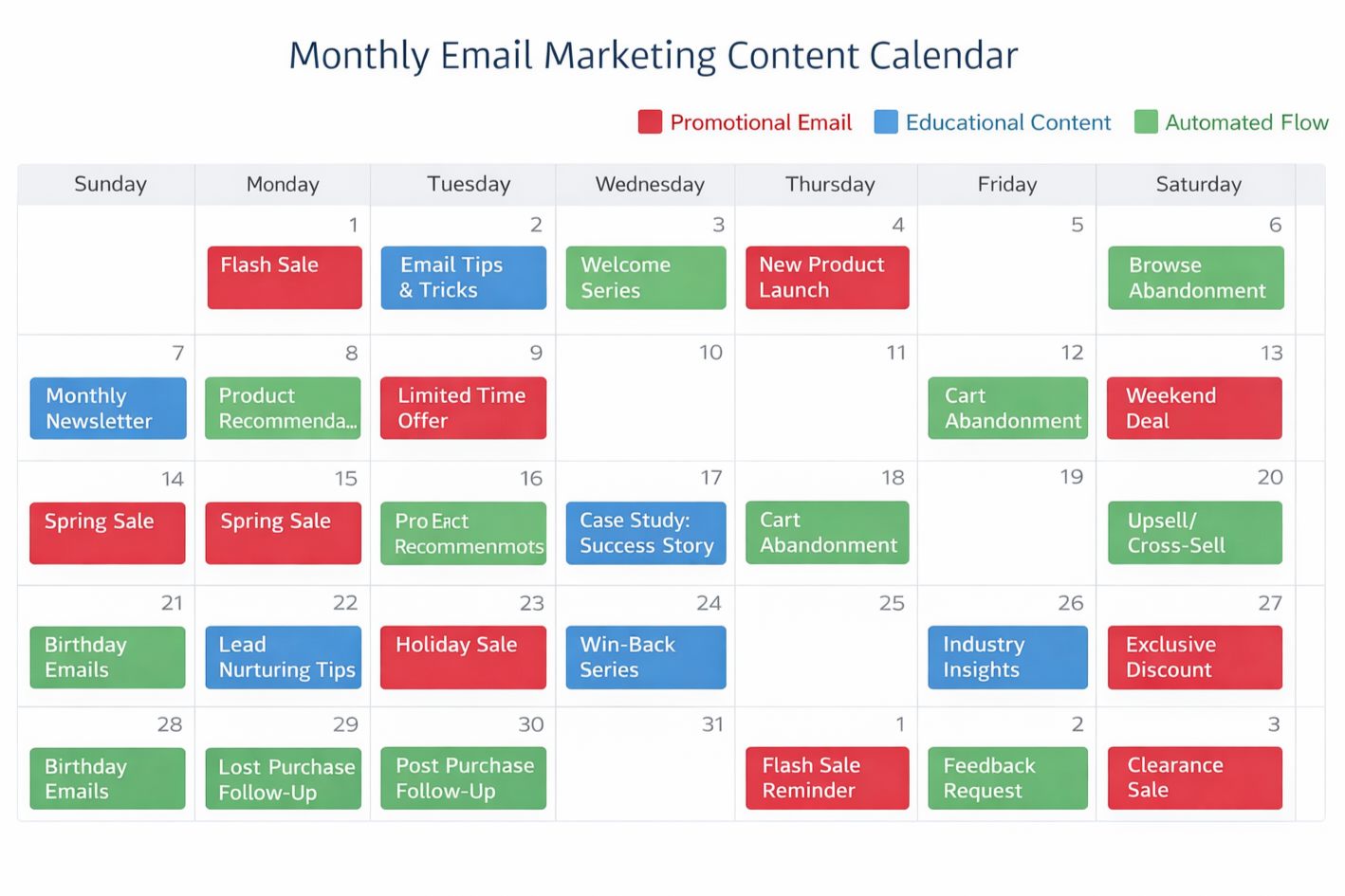
Content Calendar Structure
Promotional vs. educational content ratio (recommend 70/30)
Campaign themes by month/quarter
Product launch schedules
Seasonal/holiday campaigns
Evergreen automation content
Message Hierarchy
Welcome series (first impression messaging)
Regular newsletter (relationship building)
Promotional campaigns (revenue driving)
Lifecycle triggers (behavior-based)
Re-engagement (relationship repair)
Each content type serves a different strategic purpose. Your strategy should outline the role of each content type and how they work together.
Content planning best practice: Plan quarterly themes and monthly campaigns, but maintain flexibility for timely opportunities. Over-planning kills agility.
Automation and Workflow Strategy
Email automation is where strategy becomes scalable revenue. But automation without strategy is just automated mediocrity.
Strategic automation framework:
Essential Automated Flows
Welcome Series (Days 0-7)
Set expectations and deliver promised value
Introduce brand story and mission
Highlight key products or services
Build engagement habit
Goal: Convert subscribers to engaged audience
Abandoned Cart Series (Hours to Days)
Reminder (1 hour)
Social proof (24 hours)
Incentive (48 hours)
Goal: Recover 15-30% of abandoned revenue
Post-Purchase Series (Days to Weeks)
Order confirmation and tracking
Product education and usage tips
Satisfaction check-in
Cross-sell and upsell
Review request
Goal: Ensure success and drive repeat purchase
Browse Abandonment Series
Product recommendation
Educational content
Similar products
Goal: Convert browsers to buyers
Re-engagement Series (30-90 days inactive)
"We miss you" message
Preference update
Special incentive
Final opt-in confirmation
Goal: Wake up inactive subscribers
Customer Lifecycle Automations
Milestone celebrations (birthdays, anniversaries)
Replenishment reminders (for consumables)
VIP program triggers
Win-back campaigns
Referral requests
Each automation should have clear triggers, strategic messaging, and success metrics. Map out the complete automation ecosystem and how flows connect.
Automation optimization: Treat automations like products. Launch, measure, iterate, improve. A welcome series optimized over 12 months can perform 300% better than the original version.
Get 52 email marketing examples covering every campaign type including welcome series, abandoned cart, and post-purchase sequences.
Campaign Strategy and Promotion Planning
Campaigns are your proactive revenue drivers. Campaign strategy determines how you create urgency and drive conversions beyond automated flows.
Campaign strategic planning:
Campaign Types and Frequency
Weekly Newsletter
Relationship building and engagement
Content distribution and education
Soft product promotion
Frequency: Weekly (or bi-weekly minimum)
Promotional Campaigns
Product launches
Sales and special offers
Seasonal promotions
Limited-time deals
Frequency: 2-4x monthly (don't over-promote)
Event-Based Campaigns
Webinars and workshops
Product drops
Holiday campaigns
Industry events
Frequency: As relevant
Behavioral Trigger Campaigns
Back-in-stock alerts
Price drop notifications
Category interest follow-ups
Cart value thresholds
Frequency: As triggered
Campaign Cadence Strategy
Minimum send frequency (stay top of mind)
Maximum send frequency (avoid fatigue)
Promotional email limits per month
Content/promotional ratio
Segmentation for different send frequencies
Your campaign strategy should balance revenue generation with list health. Over-promoting burns out your list. Under-promoting leaves money on the table.
Campaign planning best practice: Plan major campaigns quarterly, optimize monthly promotional calendar, remain flexible for tactical opportunities. Always have 2-3 campaigns ready to deploy.
Advanced Email Marketing Strategy Elements
Once you have the foundation, these advanced strategic elements separate good programs from revenue-generating machines.
Segmentation Strategy for Personalization
Basic segmentation is table stakes. Advanced segmentation strategy is competitive advantage.
Advanced segmentation approaches:
Predictive Segmentation
Predicted lifetime value
Churn risk scoring
Next purchase likelihood
Product affinity modeling
Engagement-Based Segmentation
Highly engaged (opens/clicks 70%+ of emails)
Moderately engaged (30-70%)
Low engagement (under 30%)
Never engaged (no opens after welcome)
Revenue-Based Segmentation
VIP (top 5% of customers)
High-value (top 20%)
Growth potential (increasing spend)
At-risk high-value (decreasing engagement)
Behavioral Segmentation
Product category preferences
Channel preferences (mobile vs. desktop)
Content topic interests
Purchase frequency patterns
Your segmentation strategy should determine which segments get different treatment, what that treatment looks like, and how you measure segment performance.
Segmentation ROI: Properly segmented campaigns generate 760% more revenue than non-segmented campaigns. This isn't optional for serious email programs.
Testing and Optimization Strategy
Email marketing strategy without testing and optimization is just expensive guessing. Your testing strategy should be systematic, not random.
Strategic testing framework:
What to Test (Priority Order)
High-Impact Tests
Subject lines (biggest open rate impact)
Send time optimization (affects opens and clicks)
Primary CTA placement and copy (affects revenue)
Email structure (single vs. multiple offers)
Personalization elements (name, products, content)
Medium-Impact Tests
Preview text optimization
From name variations
Email length (short vs. long)
Visual vs. text-heavy design
Urgency and scarcity elements
Low-Impact Tests
Button colors
Specific word choices
Font selections
Image placement details
Testing Methodology
Minimum list size for statistical significance (5,000+ per variant)
Confidence level requirement (95% minimum)
Test duration (enough time to reach significance)
Documentation and learning capture
Winner implementation process
Your optimization strategy should include testing cadence, documentation process, and how learnings get implemented across the program.
Testing best practice: Test one variable at a time. Run 2-4 A/B tests monthly. Document everything. Implement winners immediately. Share learnings across team.
Deliverability and List Hygiene Strategy
The best email strategy in the world means nothing if your emails don't reach inboxes. Deliverability strategy is fundamental.
Deliverability strategic framework:
Technical Infrastructure
Authentication (SPF, DKIM, DMARC)
Dedicated IP vs. shared IP strategy
Domain reputation monitoring
Feedback loops with ISPs
Bounce handling protocols
List Hygiene Practices
Regular inactive subscriber removal
Invalid email address cleaning
Re-engagement campaigns before removal
Double opt-in implementation
Engagement-based list pruning
Sender Reputation Management
Complaint rate monitoring (keep under 0.1%)
Bounce rate tracking (keep under 2%)
Engagement rate optimization
IP warming protocols
Domain reputation tracking
Content Optimization
Spam trigger word avoidance
Link and image ratio optimization
HTML code quality
Mobile optimization
Authentication consistency
Your deliverability strategy should outline monitoring frequency, acceptable metric ranges, and remediation protocols when issues arise.
Deliverability reality: A 98% inbox placement rate vs. 85% placement rate on a 100K list means 13,000 more people see your emails. That's massive revenue impact.
Attribution and Revenue Optimization
Your email marketing strategy must connect email performance to actual business revenue. Attribution strategy determines how you prove ROI.
Revenue attribution framework:
Attribution Models
Last-Click Attribution
Credits email for purchases made directly from email
Pros: Simple, easy to implement
Cons: Undervalues email's influence
Multi-Touch Attribution
Credits email based on touchpoint influence
Pros: More accurate picture of email's role
Cons: Complex to implement
Incremental Attribution
Measures lift from email vs. control group
Pros: True incremental value measurement
Cons: Requires sophisticated testing
Revenue Optimization Strategies
AOV (average order value) optimization
Purchase frequency increase
Customer lifetime value extension
Win-back revenue capture
Cross-sell and upsell programs
Your strategy should include which attribution model you use, how you measure incremental value, and what optimization levers drive revenue growth.
Attribution best practice: Start with last-click for simplicity, add multi-touch attribution as you scale, implement incrementality testing for major decisions.
Measuring Email Marketing Strategy Success
Strategy without measurement is just hope. Your measurement framework should connect email metrics to business outcomes.
Key Performance Indicators (KPIs) Framework
Not all metrics matter equally. Focus on metrics that connect to business objectives.
Primary Strategic Metrics
Revenue Metrics
Total email-attributed revenue
Revenue per subscriber
Revenue per email sent
Email percentage of total revenue
Return on email marketing investment
List Health Metrics
List growth rate
Engaged subscriber count
Engaged subscriber percentage
List churn rate
Average subscriber lifetime
Engagement Metrics
Open rate (benchmark: 20-30% for e-commerce)
Click rate (benchmark: 2-5% for e-commerce)
Conversion rate (benchmark: 1-3% for e-commerce)
Click-to-open rate (benchmark: 15-25%)
Lifecycle Metrics
Welcome series conversion rate
Cart abandonment recovery rate
Customer repeat purchase rate
Re-engagement campaign success rate
Average customer lifetime value
Secondary Tactical Metrics
Deliverability rate
Bounce rate
Complaint rate
Unsubscribe rate
Forward/share rate
Your KPI framework should have 5-7 primary metrics you review weekly, 10-15 secondary metrics reviewed monthly, and clear targets for each.
Performance Benchmarking and Optimization
Strategy requires knowing where you stand and where you're going. Benchmarking provides context.
Benchmarking framework:
Internal Benchmarks
Your performance over time
Year-over-year comparisons
Trend analysis (improving or declining)
Campaign performance comparisons
Industry Benchmarks
E-commerce: 20-25% open rate, 2-4% click rate
SaaS: 22-27% open rate, 3-5% click rate
Media/Publishing: 25-30% open rate, 4-6% click rate
Professional Services: 20-23% open rate, 2-3% click rate
Competitive Benchmarks
Direct competitor analysis (via competitive intelligence tools)
Market share of inbox
Send frequency comparison
Campaign type analysis
Best-in-Class Targets
Top quartile performance goals
Stretch targets for optimization
Long-term performance aspirations
Your benchmarking strategy should include quarterly performance reviews, competitive analysis, and clear optimization priorities based on gaps.
Strategy Review and Iteration Cadence
Email marketing strategy isn't set-it-and-forget-it. Strategic review ensures continuous improvement.
Strategy review schedule:
Weekly Reviews
Campaign performance analysis
Immediate optimization opportunities
Tactical adjustments
Monthly Reviews
KPI performance vs. targets
Automation performance
Testing results and learnings
Content performance
List health metrics
Quarterly Reviews
Strategic objective progress
Competitive landscape changes
Major program improvements
Resource allocation
Technology evaluation
Annual Reviews
Complete strategy refresh
Objective setting for next year
Budget planning
Team capability assessment
Technology stack optimization
Each review should result in specific action items, owners, and deadlines. Strategy only works when you execute and iterate.
Building Your Email Marketing Strategy: Step-by-Step
Ready to build your strategy? Here's the exact process for creating a documented email marketing strategy that drives results.
Step 1: Conduct Strategic Audit (Week 1)
Before planning forward, understand where you are now.
Current state assessment:
List size and growth rate
Current email performance metrics
Existing campaigns and automations
Technology stack and capabilities
Team resources and skills
Budget and investment levels
Gap analysis:
What's working well?
What's underperforming?
What's missing entirely?
What opportunities exist?
What threats or challenges?
Competitive analysis:
What are competitors doing?
What can you learn from their approach?
Where are differentiation opportunities?
What tactics might you adapt?
Document everything. You need clear baseline understanding before building strategy.
Step 2: Define Strategic Objectives and Targets (Week 1)
With audit complete, set clear objectives and measurable targets.
Objective setting framework:
Choose 2-3 primary business objectives
Set specific, measurable targets
Define timeline for achievement
Identify required resources
Outline success criteria
Example objectives:
Increase email-attributed revenue from $500K to $1.5M in 12 months
Grow engaged subscriber base from 20K to 50K in 6 months
Increase customer repeat purchase rate from 15% to 30% in 9 months
Make objectives SMART: Specific, Measurable, Achievable, Relevant, Time-bound.
Step 3: Develop Audience and Segmentation Strategy (Week 2)
Define exactly who you're talking to and how you'll segment them.
Audience strategy development:
Create detailed audience personas
Map customer journey by persona
Define lifecycle stages
Outline segmentation criteria
Prioritize segment development
Start with foundational segments (lifecycle stages), add behavioral segments as you scale.
Step 4: Build Content and Campaign Strategy (Week 2-3)
Determine what you'll send, when, and why.
Content strategy creation:
Define content pillars (3-5 themes)
Establish content calendar framework
Plan promotional campaign calendar
Outline newsletter structure and frequency
Create content production process
Plan high-level quarterly themes, detailed monthly campaigns.
Step 5: Design Automation Ecosystem (Week 3-4)
Map complete automation strategy and prioritize implementation.
Automation planning:
List all needed automations
Prioritize by business impact
Define triggers and logic
Outline messaging and offers
Create implementation timeline
Priority implementation order:
Welcome series (highest impact)
Abandoned cart recovery (quick revenue win)
Post-purchase series (retention foundation)
Browse abandonment (revenue expansion)
Re-engagement (list health)
Build foundational flows first, add sophistication over time.
Step 6: Establish Measurement Framework (Week 4)
Define how you'll measure success and optimize performance.
Measurement strategy:
Select primary KPIs (5-7 metrics)
Define secondary metrics (10-15 metrics)
Set targets for each metric
Create reporting dashboards
Establish review cadence
Build reporting before you launch so you can track from day one.
Step 7: Document and Socialize Strategy (Week 4)
Create documented strategy and get organizational buy-in.
Strategy documentation:
Executive summary (1 page)
Complete strategy document (10-15 pages)
Implementation roadmap (timeline and owners)
Resource requirements (team, budget, tech)
Success metrics and reporting
Stakeholder alignment:
Present to leadership for approval
Share with marketing team
Train execution team
Establish accountability
Create feedback loops
Strategy only works when everyone understands it and commits to execution.
Common Email Marketing Strategy Mistakes
Learn from others' mistakes. Avoid these common strategic errors that kill email program performance.
Mistake 1: Confusing Tactics with Strategy
The Problem: Businesses think their automation workflows or content calendar IS their strategy. Those are tactics. Strategy is the why behind the what.
The Fix: Document clear objectives, audience strategy, and measurement framework before building tactical plans. Strategy answers "why" and "who," tactics answer "what" and "how."
Mistake 2: Building for Vanity Metrics
The Problem: Optimizing for open rates or list size instead of revenue and engagement. You can have a huge list with terrible revenue performance.
The Fix: Focus on metrics that connect to business outcomes. Revenue per subscriber matters infinitely more than total subscriber count.
Mistake 3: No Segmentation Strategy
The Problem: Sending the same emails to everyone. A VIP customer and a cold subscriber don't need the same message.
The Fix: Start with basic lifecycle segmentation. Add behavioral and value-based segments as you mature. Different audiences need different strategies.
Mistake 4: Set-It-and-Forget-It Automation
The Problem: Building automations once and never optimizing them. Markets change, audiences evolve, and performance declines.
The Fix: Treat automations like products. Review performance monthly, optimize quarterly, completely refresh annually.
Mistake 5: No Testing Strategy
The Problem: Making decisions based on opinions or best practices instead of data from your actual audience.
The Fix: Implement systematic testing program. Test 2-4 variables monthly, document results, implement winners, share learnings.
Mistake 6: Ignoring List Health
The Problem: Growing list at all costs without monitoring engagement. Ends up with huge lists full of inactive subscribers killing deliverability.
The Fix: Monitor engagement rates, implement re-engagement campaigns, regularly prune inactive subscribers. Smaller engaged list beats larger unengaged list.
Mistake 7: No Strategy Documentation
The Problem: Strategy exists in someone's head. When that person leaves, the strategy leaves too.
The Fix: Document complete strategy. Create playbooks. Train team. Make strategy accessible and actionable.
Email Marketing Strategy Tools and Resources
The right tools make strategy execution significantly easier. Here's the strategic technology stack.
Email Service Providers (ESP)
Your ESP is the foundation. Choose based on your strategic needs.
For E-commerce:
Klaviyo (best for Shopify, advanced segmentation)
Omnisend (good balance features and price)
Drip (strong automation capabilities)
For SaaS and B2B:
HubSpot (complete CRM integration)
ActiveCampaign (advanced automation)
Customer.io (developer-friendly)
For Simplicity:
Mailchimp (easy to use, limited at scale)
ConvertKit (creator-focused)
Flodesk (design-focused)
Choose based on your business model, technical capabilities, and strategic priorities. Platform switching is painful, so choose wisely upfront.
Analytics and Attribution Tools
Understanding true email impact requires analytics beyond your ESP.
Attribution Platforms:
Google Analytics 4 (free, complex setup)
Triple Whale (e-commerce focused)
Northbeam (advanced multi-touch attribution)
Email-Specific Analytics:
Litmus Email Analytics (rendering and engagement)
Email on Acid (deliverability monitoring)
Inbox Monster (spam testing)
Revenue Analytics:
Your ESP's native reporting (start here)
Business intelligence tools (Tableau, Looker)
Custom data warehouse (advanced setups)
Analytics strategy should match your sophistication level. Start simple, add complexity as you scale.
Automation and Workflow Tools
Building complex automation at scale requires specialized tools.
Workflow Builders:
Your ESP's native builder (start here)
Zapier (connect apps)
Make/Integromat (advanced automation)
Customer Data Platforms:
Segment (data collection and routing)
mParticle (enterprise customer data)
RudderStack (open-source alternative)
Personalization Engines:
Dynamic Yield (advanced personalization)
Monetate (e-commerce personalization)
ESP native personalization (most have good options)
Only add specialized tools when ESP limitations prevent strategic execution.
Content Creation and Design Tools
Executing content strategy requires efficient creation tools.
Email Design:
Your ESP's drag-and-drop builder
Stripo (advanced email builder)
Figma (design mockups)
Canva (quick graphics)
Content Planning:
Notion (content calendar and planning)
Airtable (campaign planning database)
Asana/Monday (project management)
Google Sheets (simple and free)
Copywriting Tools:
Hemingway (clarity and readability)
Grammarly (grammar and tone)
ChatGPT (ideation and drafts, not final copy)
Image Resources:
Product photography (hire professional)
Stock photos (Unsplash, Pexels)
Icons (Noun Project)
Screenshots (Snagit, CloudApp)
Tool strategy: Start minimal, add specialized tools only when limitations slow execution.
Industry-Specific Email Marketing Strategies
Different industries require different strategic approaches. Here's how strategy adapts by industry.
E-commerce Email Marketing Strategy
E-commerce email marketing focuses on driving purchases, increasing AOV, and building customer lifetime value.
Strategic priorities:
Abandoned cart and browse recovery (15-30% revenue recovery)
Post-purchase upsell and cross-sell (increase AOV 20-40%)
Replenishment and reorder campaigns (for consumables)
VIP program and loyalty (drive repeat purchase)
Product launch and promotion (create urgency)
E-commerce strategic framework:
Welcome series with product recommendations
Browse and cart abandonment flows
Post-purchase education and upsell
Back-in-stock and price drop alerts
Win-back campaigns for churned customers
E-commerce benchmarks:
Email should drive 25-35% of total revenue
Automation should generate 40-60% of email revenue
Engaged subscribers have 3-5x higher LTV
E-commerce email strategy is all about maximizing revenue per subscriber through sophisticated automation and personalization.
SaaS Email Marketing Strategy
SaaS email marketing focuses on onboarding, feature adoption, churn prevention, and expansion revenue.
Strategic priorities:
User onboarding and activation (drive "aha" moment)
Feature adoption campaigns (increase product stickiness)
Usage-based triggers (based on behavior, not time)
Churn prevention (identify and intervene early)
Expansion revenue (upsells and cross-sells)
SaaS strategic framework:
Onboarding series (7-14 emails over 30 days)
Feature education and best practices
Usage milestone celebrations
Re-engagement for inactive users
Upgrade and expansion campaigns
SaaS benchmarks:
Onboarding should activate 40-60% of trials
Email should influence 20-30% of upgrades
Proper email strategy reduces churn 15-25%
SaaS email strategy is about driving product adoption and preventing churn through education and engagement.
B2B Service Email Marketing Strategy
B2B services focus on trust building, lead nurturing, and demonstrating expertise over long sales cycles.
Strategic priorities:
Lead nurturing (educate over weeks/months)
Thought leadership (establish expertise)
Case studies and social proof (build trust)
Consultation and demo requests (drive conversations)
Client retention and referrals (build advocates)
B2B strategic framework:
Educational welcome series
Regular newsletter with insights
Case study campaigns
Event invitations (webinars, workshops)
Client success stories
B2B benchmarks:
Email nurturing shortens sales cycle 20-30%
Nurtured leads have 47% higher purchase value
Regular communication increases referrals 25-40%
B2B email strategy is about building relationships and demonstrating expertise over extended sales cycles.
Advanced Email Marketing Strategy Tactics
Once you've mastered fundamentals, these advanced tactics separate elite programs from good ones.
Predictive Analytics and AI-Driven Strategy
Using data and AI to predict behavior and optimize strategy proactively.
Predictive applications:
Predicted lifetime value segmentation
Churn risk scoring and intervention
Next best product recommendations
Optimal send time prediction
Content preference modeling
Implementation approach:
Start with ESP's built-in AI features
Add specialized tools as you scale
Require significant data volume (10K+ subscribers)
Test predictions against control groups
Iterate based on accuracy
Predictive strategy requires data sophistication but delivers significant performance improvements.
Cross-Channel Integration Strategy
Email doesn't exist in isolation. Integrated strategy across channels multiplies effectiveness.
Cross-channel approaches:
Email + SMS coordination (complementary, not redundant)
Email + social media retargeting (reinforce messaging)
Email + direct mail (high-value customers)
Email + push notifications (app users)
Email + website personalization (consistent experience)
Integration strategic framework:
Consistent messaging across channels
Channel-specific timing and content
Centralized customer data platform
Unified measurement and attribution
Coordinated customer journey
Cross-channel strategy requires more sophisticated technology but creates better customer experience and higher conversion rates.
Zero-Party Data Collection Strategy
First-party and zero-party data are becoming critical as third-party cookies disappear.
Zero-party data collection:
Preference centers (let subscribers tell you what they want)
Progressive profiling (collect data over time)
Surveys and feedback (ask what they need)
Quiz funnels (fun way to collect preferences)
Account profiles (voluntary information sharing)
Strategic applications:
Hyper-personalized content
Predictive recommendations
Lifecycle stage identification
Product affinity mapping
Communication preference optimization
Zero-party data strategy becomes competitive advantage as privacy regulations increase.
Community-Driven Email Strategy
Building email strategy around community creates unique engagement and loyalty.
Community integration:
User-generated content in emails
Member spotlights and success stories
Community event promotion
Discussion highlights and best threads
Exclusive community member benefits
Community email strategy:
Welcome new community members
Highlight valuable contributions
Drive engagement back to community
Celebrate community milestones
Foster member connections
Community-driven strategy creates network effects where members promote and engage with your emails.
Email Marketing Strategy for Different Business Stages
Your strategy should match your business maturity. What works for startups doesn't work for enterprises.
Startup Email Strategy (0-$1M revenue)
Focus on validation and efficiency. Resources are limited, so prioritize highest-impact activities.
Strategic priorities:
Product-market fit validation through email feedback
Simple, effective automation (welcome, cart, purchase)
Founder voice and authenticity
Lean toward action over perfection
Manual high-touch where automation doesn't exist
Startup strategic approach:
Start with Mailchimp or ConvertKit (simple, affordable)
Build welcome series and basic cart abandonment
Send regular founder updates (build early community)
Test messaging and positioning rapidly
Graduate to sophisticated tools as revenue grows
Startup strategy is about learning fast and building foundation for scale.
Growth Stage Email Strategy ($1M-$10M revenue)
Focus on scaling what works. You've found product-market fit; now multiply it.
Strategic priorities:
Scale profitable automation
Sophisticated segmentation implementation
Team building and process creation
Advanced testing and optimization
Platform selection for long-term growth
Growth stage strategic approach:
Upgrade to Klaviyo, Omnisend, or equivalent
Build complete automation ecosystem
Implement systematic testing program
Hire specialized email talent
Document processes and systems
Growth stage strategy is about building scalable systems and team capabilities.
Enterprise Email Strategy ($10M+ revenue)
Focus on sophistication and incremental optimization. Small improvements drive massive revenue.
Strategic priorities:
Advanced personalization and AI
Complex lifecycle journey orchestration
Cross-channel integration
International and multi-brand strategy
Compliance and deliverability excellence
Enterprise strategic approach:
Enterprise ESP with advanced capabilities
Dedicated email marketing team
Custom integrations and data platforms
Regular strategic consulting and optimization
Industry leadership and thought leadership
Enterprise strategy is about marginal gains and sophisticated execution at scale.
Future of Email Marketing Strategy
Email marketing continues evolving. Strategic marketers prepare for what's coming.
Privacy and Data Regulation Trends
Privacy regulations are increasing globally. Strategy must adapt.
Strategic adaptations:
Zero-party data collection emphasis
Transparent privacy policies and practices
Consent management sophistication
First-party data strategy
Email as owned channel advantage
Privacy changes make email MORE valuable as owned channel while paid advertising becomes more expensive and less targetable.
AI and Automation Evolution
AI is transforming email capabilities faster than any time in history.
AI strategic applications:
Content generation and optimization
Predictive sending and personalization
Automated testing and learning
Customer journey optimization
Real-time behavior response
AI makes sophisticated strategy accessible to smaller teams. Tools that required data scientists now work automatically.
Interactive and AMP Email
Email is becoming more interactive and app-like with AMP technology.
Interactive possibilities:
In-email shopping carts
Surveys and polls directly in email
Appointment scheduling in email
Real-time content updates
Gamification and engagement
Interactive email improves conversion by reducing friction. Strategic adoption creates competitive advantage.
Omnichannel Customer Experience
Email strategy increasingly integrates with broader customer experience strategy.
Omnichannel evolution:
Seamless channel transitions
Consistent personalization everywhere
Unified customer data platforms
Channel preference optimization
Coordinated journey orchestration
Email becomes orchestration hub for complete customer experience rather than isolated channel.
Frequently Asked Questions
How long does it take to develop an email marketing strategy?
A complete email marketing strategy takes 3-4 weeks to develop properly. Week 1 for audit and objectives, Week 2 for audience and content strategy, Week 3 for automation planning, Week 4 for documentation and alignment. Rushing produces incomplete strategy that hurts execution.
What's the difference between email marketing strategy and tactics?
Strategy is the why, who, and what (objectives, audience, approach). Tactics are the how (specific campaigns, subject lines, send times). You need strategy before tactics. Most businesses skip strategy and wonder why tactics don't work.
How often should I update my email marketing strategy?
Review strategy quarterly for tactical adjustments. Complete refresh annually for major changes. Markets evolve, audiences change, and objectives shift. Strategy should be living document, not static plan.
What budget do I need for email marketing?
Budget depends on list size and sophistication. Small businesses: $100-500/month for ESP. Mid-size: $500-2,000/month for ESP plus tools. Enterprise: $2,000-10,000+/month for technology. Plus team costs (in-house or agency). Email delivers $42 ROI per $1 spent, making it worthwhile investment.
Should I hire an agency or build in-house team?
Depends on stage and resources. Early stage: Hire expert consultant or fractional CMO for strategy, execute in-house or with freelancers. Growth stage: Build small in-house team (2-3 people) with agency support for strategy and specialized needs. Enterprise: Build complete in-house team with agency partners for specialized capabilities.
How do I get executive buy-in for email marketing strategy?
Present business case focused on revenue and ROI. Show competitive benchmarks and opportunity gaps. Outline specific objectives with timeline and required investment. Demonstrate risk (what happens if we don't invest) and opportunity (potential revenue lift). Executives approve strategy that clearly connects to business growth.
What's the biggest mistake in email marketing strategy?
The biggest mistake is having no documented strategy at all. Second biggest is confusing tactics with strategy. Third is setting vanity metric goals instead of business outcomes. Strategy drives tactics; without it, you're guessing.
How do I measure email marketing strategy success?
Measure strategy against business objectives, not just email metrics. If objective is increasing customer lifetime value, measure LTV change. If objective is revenue growth, measure email-attributed revenue growth. Connect email performance to business outcomes, not just opens and clicks.
Wrapping It Up
There you have it—everything you need to build an email marketing strategy that actually drives business results. This isn't about sending more emails or getting better open rates. It's about building a strategic revenue engine that scales with your business.
The difference between companies that generate millions from email and those that barely cover costs comes down to one thing: strategy. Tactics change, platforms evolve, but strategic thinking separates winners from everyone else.
Start with clear objectives. Understand your audience. Build systematic automation. Measure what matters. Test and optimize continuously. That's how you turn email marketing from a cost center into your most profitable channel.
The businesses crushing it with email aren't smarter or luckier. They just have better strategy and execute it relentlessly. Now you have the same framework. Time to put it to work.
Quick Win: Block 4 hours this week. Use the step-by-step framework in this guide to draft your email marketing strategy. Document objectives, audience, and key tactics. Share with your team. Start executing. Strategy only works when you actually do it.